
Always negotiate—that’s the best way to resolve conflicts
Michael Tsur has been a member of teams sent by Israel to negotiate crisis situations for many years. To Riflessi, he explains his point of view
Mr. Tsur, reading the book You co-authored with Frediano Finucci, one is struck first and foremost by the great human and cultural richness of your family of origin – spanning Europe and Africa, Germany and Yemen – where up to seven languages were spoken. To what extent did this family background influence Your decision to become a negotiator?

First of all, let me say that my father, who was born in Germany, spent some time in Italy during and a little while after World War II before he was able to reach Israel, so even though I don’t speak Italian, your language has a familiar ring to it. At home there was always an atmosphere where the smells and flavors of the kitchen, the languages spoken, and the ways of thinking were always very diverse: I spent my childhood in a multicultural environment. When I think about it, I believe this influenced my decision to pursue a career in negotiation in three ways. First, as I mentioned, I have always been accustomed to living in an environment where perspectives were not the same. Even just going to the old market in Jerusalem was a very formative experience, being in contact with Arabs, Jews, and Christians. So for me, from the very beginning, it was natural to understand that there are different languages, cultures, and points of view in the world. Furthermore, the fact that different languages were spoken at home, and that not everyone understood the others’ language, meant that I grew up knowing that misunderstandings are always possible in communication. At the same time, I grew up with the idea that this need not be an obstacle to reaching a common understanding, or at least that it is possible to bridge different perspectives. Finally, the multicultural environment in which I grew up accustomed me to living with differences, which never frightened me. Today I speak three languages fluently, and I know that when I meet someone who speaks a different language than I do, I can still try to understand them—especially without ever losing my patience or having concerns about what is said which is an essential quality when negotiating.
The book recounts many instances in which Your team was called upon to intervene and negotiate a nonviolent solution to even the most difficult crises. How does it feel when You finally achieve the desired outcome? And when you fail?
To answer this question, we must first understand what constitutes a victory and what constitutes a defeat. I would like to clarify that I never negotiate on my own behalf, but always as part of a team that includes military personnel, which means I am accountable to the IDF. Furthermore, it is essential to understand the starting point of each situation, as the objectives vary from case to case. For example, sometimes success simply means securing a delay of a few hours during negotiations, which is more of a tactical approach, to allow the military, for instance, to operate more effectively. In other situations, however, we are entrusted with greater responsibility, and our goal is to reach an agreement that avoids the use of violence and weapons. If you ask me what success is, I would therefore say that for me, success is establishing constructive communication with those on the other side. I do not want to and must not win at all costs; my goal is to establish a channel of communication, to bring rationality to the negotiating table, not to impose my point of view. This is the goal I set for myself every time. To achieve results, it is important to avoid an aggressive tone and attitude. Our goal is often to convince military authorities that a result can be achieved even without the use of force. As you can understand, negotiation takes place not only externally but also internally, with one’s own counterparts; and it is not necessarily the case that negotiation with those on the other side is more difficult than negotiating with those on our own side… In any case, we should remember that negotiation is about succeeding and not about winning.
Together with Finucci, you also address the current situation – that is, the one that arose after October 7, 2023, and the Hamas attack. What struck me is that You examine the events that occurred rationally without ruling out the possibility of negotiating even with ruthless terrorists. How difficult is it to seek mediation with those who want nothing but your death?
 When I sit down at the negotiating table with the other side, I never think of them as crazy people, but as individuals who have a different point of view from mine. When negotiating, it doesn’t matter who you’re talking to; what matters is staying focused on the goal. So I don’t have to convince the other person that I’m right and they’re wrong, because this cannot be achieved. Negotiation begins when we realize that on the other side there are people who see the circumstances from a different perspective than ours. My goal, therefore, is to understand the situation before me and the perspective of the person across from me. I repeat: my goal is not to prove myself right, but to make progress from the starting point. And always remember that the process of negotiation occurs in the other party’s head.
In some cases, including the release of Israeli hostages after October 7, Your negotiation efforts were hindered by political interference.
I don’t want to talk about how the Army or the government has acted over the past two years. An attempt was made to negotiate, but it didn’t go anywhere. From my perspective, factors that hindered the process were present from the very beginning—in particular, emotions such as the desire for revenge, for repaying in kind what we had suffered. All of this inevitably comes at a price. Negotiations require acknowledgements from both sides. Furthermore, when negotiating, we must be aware that it will not be possible to undo the past, what has already happened. Negotiations can, if anything, seek to relate to the future. If negotiations are driven by a desire for revenge, they will not achieve any improvement. I would rather highlight a positive development. As we speak, negotiations have begun between Israel and Lebanon, currently taking place in Washington and probably at other levels and in other places. These negotiations were made possible by the achievement of a ceasefire, which is the prerequisite for launching effective negotiations. Indeed, if shots are being fired and damage caused to people or property, it is difficult if not impossible to negotiate at the same time.
May I ask what your assessment of Benjamin Netanyahu is, and whether, in your view, the Israeli government’s current actions are moving toward achieving a balance in the Middle East?
Once again, I must tell you that it is not my job to judge the government. Certainly, from his perspective, Netanyahu believed he was doing what he considered the best solution. But Netanyahu is a politician, and I am a negotiator. My job is to find an opportunity that will allow a different reality; I am not the prime minister.
May I ask whether your work as a negotiator has become easier or more difficult over the past two years?
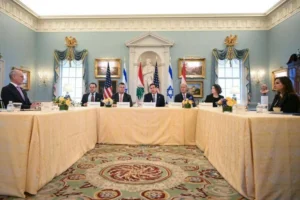
It depends. Certainly, negotiating with the military was very difficult, because a war was underway. Furthermore, we must consider that Israel, traumatized by October 7, has been living in a context of great tension, which has not made it easier to negotiate. The geopolitical context has indeed changed profoundly over the past two years, and this has also altered the opportunities available during negotiations. However, I can say that we must never give up on seizing an opportunity to make progress when it presents itself, and from my point of view, quite a few opportunities came up in the last few years
If You were called upon to serve as a negotiator in direct talks between the United States and Iran, where would you begin to find common ground?
That’s a very theoretical question. First of all, we don’t know exactly what the terms of the negotiation are. What we saw in Islamabad was a media spectacle, but negotiations aren’t usually conducted in front of the cameras. What exactly was the mandate given to the negotiators? To genuinely seek an agreement, or just to put on a show? Furthermore, which parties have an interest in making progress, or conversely, in seeing the negotiations fail? Is there a real possibility of finding common ground? If there is no common ground, the negotiations cannot begin. Additionally, we should also consider whether other parties can intervene to help achieve our goal. I’m thinking of India, Russia, and even Europe. Before deciding how to proceed, we need to try to understand who we are representing and all the elements necessary for the negotiation. A big part of negotiation is what we call “PPP”: prepare, prepare, prepare.
May I ask for your assessment of Donald Trump’s negotiating skills?
Do you want a technical answer?
Certainly.
From my point of view, I cannot identify any structured method in President Trump’s negotiation style and approach. It seems to me that he is driven strongly by the need to draw attention; his communication style is very aggressive, and aggression is never helpful at the negotiating table. The way I see it, generally, aggression or the use of power and force is a sign of weakness.
One last question. I don’t know if You’re a religious Jew, but You’re surely familiar with the story of Abraham bargaining with God to save Sodom from destruction because of its inhabitants’ sins. In the end, the city is destroyed because not even ten righteous people can be found within it. In Your opinion, did Abraham do everything he could, or could he have negotiated a lower number to secure the city’s salvation?
Well, I’d start by saying that, after all, Abraham did secure the salvation of his nephew Lot and his family—his wife and daughters. His sons-in-law could have been saved too, if they’d wanted to. The episode of the bargaining between Abraham and God is surprising, considering that God decides to agree to bargain with a human being. In any case, I wouldn’t be too hard on Abraham. We must consider that, while the other party is omniscient—and therefore knew exactly how many righteous people were in Sodom—Abraham did not possess this information; he was thus in the worst possible position to conduct a negotiation: when there is a knowledge gap between those sitting at the table, the one with more information always has the advantage over the other. In general, the Torah gives us other examples of great negotiators. Think of Moses, who repeatedly intercedes to save his people’s lives and always manages to bring them to safety, even if there is sometimes a price to pay. Finally, the case of Abraham and Sodom is highly instructive, because we can find two principles in it that I, too, draw inspiration from daily in my work.
Which ones?
The first is that Abraham, despite facing difficulties for the reasons I mentioned, never ceases to maintain a proactive attitude. This is a fundamental attitude in negotiation: never give up, never be passive, but always seek progress. So even negotiate with God, if necessary! We should always remember, as long as we are communicating, it’s not “No”, it’s “not yet”.
And the second lesson?
God teaches us that he prefers a bad ending to a never-ending bad. In other words, it is better to pay a price—even a high one—than to continue living in an ongoing state of terror, suffering and difficulty This relates to all kinds of relationship and unfortunate situations.